I've noticed somthing about Facebook that I think illustrates the way people think in light of their politics. It's election season, and that means a lot of Facebook statuses talking about it. I have friends -- both real friends and the Facebook kind -- on both ends of the political spectrum. Which means that, by definition, my friends and I all don't agree on politics.
But I've noticed that when it comes to Facebook friends, who they plan to vote for informs how they react to others' politics. There's been a solid uptick in statuses lately that hew to some variant of the following: "I can't wait for this election to be over. Some people spend way too much time on Facebook talking about their candidate. Does anyone really think they're going to change anyone's mind in regards to how they vote? Can we all just agree to stop talking about politics and stick to posts about kids, gardens, vacations, and things like that? You know -- important things?"
I've seen some version of that post by four different poeple in the last month and half, by my recollection. That in itself isn't all that interesting. What's interesting is that, based on other posts they've either made, liked, or commented on, it's pretty clear who exactly they'll be voting for in November. In every case I think it is safe to say they'll be pulling the lever for the status quo. Which is fine, of course. Everyone who is eligible to vote has a right to cast the vote for whomever they wish -- even if they're completely wrong.
No, what makes this interesting is not who they're voting for, but rather their preferred reaction to reading -- or presumably becoming aware of the gist of, since I don't think there's a law that says you have to read everything a Facebook friend posts -- political statements that don't gibe with their own views. Let's take a look at the options available to a Facebook user.
When you see that someone has posted a status or link on Facebook that you don't agree with and/or don't want to read, you can:
(A) Read it anyway; since if they're your friend and took the time to post something the least you can do is take the time to read it.
(B) Skip over it and look for more posts about waterskiing cats and lists of reasons why music today sucks.
(C) Wonder why you were ever Facebook friends with that person in the first place and unfriend them.
(D) Attempt to influence what other people feel comfortable posting on Facebook by calling for moratoriums on certain subjects.
Now, I don't think anyone in history has ever chosen option (A), and that's okay. Option (B) is what I usually do, though there are times I will read it if it looks like a useful link (i.e. not say, the Daily Kos or Democratic Underground. I may be an occasionally incredulous reader of Salon, Slate, and the Huffington Post in an effort to keep my horizons broadened, but I'm not crazy). And I will admit there are times when option (C) is sorely tempting.
At no time have I ever seen option (D) taken by a conservative friend though, and I think that's telling. There's a certain air to liberalism that seems to imbue adherents with the feeling that their cause is so just, their ideology so pure and self-evidently right, that it's only natural to try and shut other points of view down. We see it on a large scale when there are concerted efforts by leftwing groups to get Rush Limbaugh off the air. We see it when companies don't have the right viewpoint. And we see it at perhaps its most repugnant point when people don't vote the way people of their ethnic group are expected.
Back on Facebook, this tendency to argue that politics should just be left out of the sphere of acceptable topics is undercut by a simple search of the authors' timelines. In my personal experience, it's not hard to find examples of those same people liking and commenting on statuses and links from people who share their leanings. And hey, that's fine. But it's pretty disingenuous to turn around and play the "can't we just talk about kittehs?" card.
I talked about liberals being imbued with a feeling earlier, and I think that inadvertently got to the heart of the difference between liberals and conservatives. Liberals feel. They see inequality in the world and think, that's not fair. If people would just work together and sacrifice, we could get rid of hunger/poverty/homelessness/want/need/lack of iPhones for all. The problem is that that deep feeling is always steeped in the same foundation: but not me.
Occupy protesters marched around (then later, when they got tired, camped) shouting out poorly metered slogans about all sorts of injustices: the war in Afghanistan, Wall Street, the bottoming housing market, the inability of people with masters degrees in puppetry to find work. Among the homeless, the criminals and the people with nothing better to do were a lot of people who were spending a lot of time complaining that they wanted more and other people had it and why doesn't somebody make them give it to us? Take a look at this vignette from Occupy Wall Street that aired on the Daily Show. Watch the whole thing, as it's both funny and enlightening. But pay close attention to the 4:15 mark, when a man goes to great lengths to espouse the idea that everyone should have access to all the goodies life has to offer. Private property is evidently wrong because it deprives people of access to "the goods of life". Not his iPad though, because that's his. As he says, "I'm more against private property than personal property." In other words, "my stuff is mine, but other people's stuff should be made available to everyone".
That's not to say that convervatives don't feel, and it certainly shouldn't be taken as gospel that conservatives don't care about the poor or the homeless or the hungry. We just don't think government is the best way to address it, and that in that capacity to which government involvement is necessary, the goal should be to reduce the number of people dependent on aid. Instead, we seem intent on seeing how far the balance between those dependent on government handouts and those expected to pay for them can tilt until the whole thing collapses. The eminent sage Homer Simpson once declared that alcohol was "the cause of -- and solution to -- all of life's problems. Right and Left split that dichotomy when it comes to statism. The Right sees government as the cause, the Left as the solution.
So, to any Facebook friends who might be reading this, let me say, no.
No, I won't stop writing about politics, or posting statuses that make clear in no uncertain terms that I think our current president is far, far worse than George W. Bush on his worst day -- and W. doesn't exactly stand next to Reagan in my personal pantheon.
No, I won't stop posting links that point out all the ugly, horrible, racist things that liberals say and do. Precisely because your side regards it as self-evident that conservatives are racist by definition, as though proclaiming your support for Obama magically cloaks you from racism charges while simultaneously calling Stacey Dash an Uncle Tom (and far, far worse).
No, I won't stop posting links to malfeasence on the part of a press that frets over funding for Big Bird but can't quite bring itself to dig into Benghazi, Eric Holder, or the deliberate attempt to destroy a functioning energy base (coal and oil) for one that doesn't work no matter how much money we flush down the toilet.
If that means we can't be Facebook friends, I understand. I'll just have to figure out a way to overcome the loss of hearing about kids I've never met and cats I don't like (seriously, I don't see the upside to cats). I'll have to muddle through without your invitations to install Facebook apps that invariably infect my computer with viruses. Some of you I would genuinely miss, so I hope you don't dismiss me. But as for others, I'll take solace in the fact that I'll have one less "friend" telling me what is and is not acceptable to post.

Showing posts with label Unsolicited Opinions. Show all posts
Showing posts with label Unsolicited Opinions. Show all posts
Sunday, October 14, 2012


Friday, January 27, 2012
As "Real Journalism" Dies, Have Real Journalists Stopped Caring?
I have a pet theory I'm kicking around. It goes like this: as traditional news media declines and the war between "real journalists" and serious news bloggers (note: I am not one of these) who, while not offically working for a news outlet, nevertheless function as journalists begins to tilt to the side wearing the pajamas, traditional news suffer a loss of prestige.
That slide results in a drop in quality on three fronts: first, less people are eager to be identified with traditional journalism. After all, who volunteers to associate with a dying endeavor?
Second, those who do decide to go the traditional media route are less skilled and/or professional.
Third, those already established in the media either try to get out, or at the least stop caring about it.
I have no idea which of those categories applies to David Adams of Reuters, since, as I am not a journalist, I don't have to go research Mr. Adams' background to figure out when he graduated college. However, it's pretty clear that whichever bucket he falls into, he is a data point in favor of my theory.
That slide results in a drop in quality on three fronts: first, less people are eager to be identified with traditional journalism. After all, who volunteers to associate with a dying endeavor?
Second, those who do decide to go the traditional media route are less skilled and/or professional.
Third, those already established in the media either try to get out, or at the least stop caring about it.
I have no idea which of those categories applies to David Adams of Reuters, since, as I am not a journalist, I don't have to go research Mr. Adams' background to figure out when he graduated college. However, it's pretty clear that whichever bucket he falls into, he is a data point in favor of my theory.
Thursday, October 20, 2011
Marriage Urban Legend Still Persists
I read Dan Savage's column at the Onion AV Club every Wednesday. I do this because I think it's funny. I overlook his complete aversion to all things illiberal and his clear disdain for traditional one-man-one-woman monogamy. He's funny and unserious in a way that someone, like, say, Slate's Dear Prudence is not. Seriously, Slate, tell that woman to stop trying to be funny.
But while I can roll my eyes at Savage's unprovoked attacks on religion, Conservatism and monogamy, I had to refrain from firing off an email when I read his column this week. I'm a bit surprised that someone who considers themself as smart and savvy as Savage is still repeating this fallacy in 2011:
Anyway, the idea that half of all marriages end in divorce is an urban legend that grew from a misinterpreted study during the "divorce boom" of the 1970's. That's the time when "no-fault" divorce came into vogue and divorces became much easier to get. The numbers did spike after the rules were eased, but nowhere near the point where "half of all marriages end in divorce".
How did it come about? Well, it turns out that it's another case of schools spending too much time teaching about recycling and self-esteem instead of something useful, like statistics or basic critical thinking.
If you look at the statistics from a given year, there are years where the number of divorces is about half of the number of marriages. That's a 50% divorce rate, right? Wrong. Put the reusable grocery bag down and pay attention for a second.
Warning: made-up statistics for illutrative purposes ahead.
Let's say that in 2010 there were two million marriages. Also in 2010 let's say there were one million divorces granted. Does this mean:
A. half of marriages ended in divorce
B. half of marriages that took place in 2010 ended in divorce
C. neither a nor b is correct, but divorce lawyers probably made out all right.
The answer is C. If you have normal levels of self esteem you probably already see why. But if your sense of self-worth has been inflated to unhealthy levels by your years in the public school system -- time that would have been better spent on math -- I will spell it out for you.
The numbers in any given year do not take into account that there are already tens of millions of married couples in the US. The only way that two million marriages in 2010 + one million divorces in 2010 equals a 50% divorce rate is if the total number of married couples before 2010 was zero.
Furthermore, the only way that two million marriages in 2010 + one million divorces in 2010 equals a 50% divorce rate for marriages that took place in 2010 is if all the divorces were filed by couples married in 2010. In other words, any married couples that existed prior to 2010 all stayed happily married while only those couples married in 2010 were represented by divorce lawyers.
Is that possible? Sure, I guess. It's possible you'll get pinned beneath a meteorite only to be saved when that meteroite gets split by a lightning strike, revealing a winning powerball ticket that was embedded in the meteorite. That's not likely.
Anyway, the next time you read that "half of all marriages end in divorce" point and laugh, but don't believe it.
Update: I got asked on Facebook what I thought the real rate was. I answered the question with some off-the-cuff research, but I thought I'd update this post as well for posterity's sake.
You'd think this would be an easy question to answer, and it sort of was. Not in the "type 'what's the real divorce rate' into a search and engine and be done" sort of way, but I was able to piece together and answer.
From this article I was able to get the latest census claims that 48% of households in the US are married couples.
From here I was able to determine that in 2010 the census says there were 114,825,428 households in the US.
Simple math tells me that 48% of 114,825,428 = 55,116,205 married couples.
According to the CDC (apparently taking a break from finding a cure to the zombie apocalypse), there were over 2 million marriages a year each year from 2000 to 2009 and between 800,000 and 955,000 divorces over the same period.
Since we're comparing 2010 households with 2009 (and earlier) marriage and divorce data, I'll use numbers that are both plausible and err to the side of making my case seem worse off: the low end of the marriage scale (2 million marriages) and the upper bound of the divorce scale, plus a little to make it round (1 million divorces).
55,116,205 + 2 million marriages = 57,116,205 married couples. Divide that into the 1 million divorces, and you get roughly 1.8% as a divorce rate, which is a far cry from "50% if all marriages end in divorce".
(Thanks to truthorfiction.com for some of the background information in this post.)
But while I can roll my eyes at Savage's unprovoked attacks on religion, Conservatism and monogamy, I had to refrain from firing off an email when I read his column this week. I'm a bit surprised that someone who considers themself as smart and savvy as Savage is still repeating this fallacy in 2011:
Half of all opposite-sex marriages end in divorce, TSBM, which makes it pretty easy to deflect arguments about a gay divorce somehow proving that same-sexers aren’t worthy. And divorce—access to the courts to divide up joint property, work out custody arrangements, determine spousal support, etc.—is one of the important rights that comes with marriage.Oh, I should mention that Savage's column is not for the easily offended or those who like their sex vanilla and their gays in Paree in the 1880's. I guess this paragraph should have come earlier. Oops.
Anyway, the idea that half of all marriages end in divorce is an urban legend that grew from a misinterpreted study during the "divorce boom" of the 1970's. That's the time when "no-fault" divorce came into vogue and divorces became much easier to get. The numbers did spike after the rules were eased, but nowhere near the point where "half of all marriages end in divorce".
How did it come about? Well, it turns out that it's another case of schools spending too much time teaching about recycling and self-esteem instead of something useful, like statistics or basic critical thinking.
If you look at the statistics from a given year, there are years where the number of divorces is about half of the number of marriages. That's a 50% divorce rate, right? Wrong. Put the reusable grocery bag down and pay attention for a second.
Warning: made-up statistics for illutrative purposes ahead.
Let's say that in 2010 there were two million marriages. Also in 2010 let's say there were one million divorces granted. Does this mean:
A. half of marriages ended in divorce
B. half of marriages that took place in 2010 ended in divorce
C. neither a nor b is correct, but divorce lawyers probably made out all right.
The answer is C. If you have normal levels of self esteem you probably already see why. But if your sense of self-worth has been inflated to unhealthy levels by your years in the public school system -- time that would have been better spent on math -- I will spell it out for you.
The numbers in any given year do not take into account that there are already tens of millions of married couples in the US. The only way that two million marriages in 2010 + one million divorces in 2010 equals a 50% divorce rate is if the total number of married couples before 2010 was zero.
Furthermore, the only way that two million marriages in 2010 + one million divorces in 2010 equals a 50% divorce rate for marriages that took place in 2010 is if all the divorces were filed by couples married in 2010. In other words, any married couples that existed prior to 2010 all stayed happily married while only those couples married in 2010 were represented by divorce lawyers.
Is that possible? Sure, I guess. It's possible you'll get pinned beneath a meteorite only to be saved when that meteroite gets split by a lightning strike, revealing a winning powerball ticket that was embedded in the meteorite. That's not likely.
Anyway, the next time you read that "half of all marriages end in divorce" point and laugh, but don't believe it.
Update: I got asked on Facebook what I thought the real rate was. I answered the question with some off-the-cuff research, but I thought I'd update this post as well for posterity's sake.
You'd think this would be an easy question to answer, and it sort of was. Not in the "type 'what's the real divorce rate' into a search and engine and be done" sort of way, but I was able to piece together and answer.
From this article I was able to get the latest census claims that 48% of households in the US are married couples.
From here I was able to determine that in 2010 the census says there were 114,825,428 households in the US.
Simple math tells me that 48% of 114,825,428 = 55,116,205 married couples.
According to the CDC (apparently taking a break from finding a cure to the zombie apocalypse), there were over 2 million marriages a year each year from 2000 to 2009 and between 800,000 and 955,000 divorces over the same period.
Since we're comparing 2010 households with 2009 (and earlier) marriage and divorce data, I'll use numbers that are both plausible and err to the side of making my case seem worse off: the low end of the marriage scale (2 million marriages) and the upper bound of the divorce scale, plus a little to make it round (1 million divorces).
55,116,205 + 2 million marriages = 57,116,205 married couples. Divide that into the 1 million divorces, and you get roughly 1.8% as a divorce rate, which is a far cry from "50% if all marriages end in divorce".
(Thanks to truthorfiction.com for some of the background information in this post.)
Sunday, August 28, 2011
Does Everything Have To Be Political?
ESPN long ago went down the same dark, brimstone-paved road that MTV blazed back around the time it decided that music videos were yesterday's news. The sports network -- +1 million internet points if you even know what "ESPN" stood for when it launched -- used to be a nice little channel where you could see sports highlights and live events that centered around Australian Rules Football. It was the Little Network That Could.
Then it got too big and bloated and began breeding networks (did you know there are currently seven networks in the ESPN family, and that only includes the non-internet stuff?) like the last two rabbits on Earth. It started with forays into "serious journalism" as the network made a play for the prestige ostensibly enjoyed by "real" networks. Outside the Lines, The Sports Reporters; these were efforts by ESPN to gain credibility as more than a place for jocks to get their sports fix.
At the same time, ESPN went after various other audiences; it tried to woo the teen demographic by trying to singlehandedly elevate skateboarding, motocross, snowboarding, and other "X-Games" to the status of "real sports" among mainstream America. It went after the fantasy crowd by running stories about how Stephen Strasburg's Tommy John surgery would affect your fantasy rotation. Sure, that he would miss the pro season was news, but so was how that would affect draft strategies for rotissiere leagues. It shows Little League games. College softball. Scrabble. It wants to be everything to every sports fan.
Which makes it more than a little odd that it would jeopardize that in the name of politics, of all things. Why ESPN (or any network that wasn't involved in, you know, politics) would start wearing its politics on its sleeve is beyond me. What possible reason could the network have for announcing to the world that it leans one way or the other when it comes to something so unsporting as politics? Hubris, I guess. ESPN considers itself so big and untouchable that there will never be repercussions for its actions. Or maybe they just think sports fans won't care.
I care though, and when I see that ESPN has begun picking forks in the road of partisanship -- a road it never needed to go down in the first place -- I have to shake my head and wonder why. Oh, and begin to wonder if I need to go elsewhere for my sports.
Then it got too big and bloated and began breeding networks (did you know there are currently seven networks in the ESPN family, and that only includes the non-internet stuff?) like the last two rabbits on Earth. It started with forays into "serious journalism" as the network made a play for the prestige ostensibly enjoyed by "real" networks. Outside the Lines, The Sports Reporters; these were efforts by ESPN to gain credibility as more than a place for jocks to get their sports fix.
At the same time, ESPN went after various other audiences; it tried to woo the teen demographic by trying to singlehandedly elevate skateboarding, motocross, snowboarding, and other "X-Games" to the status of "real sports" among mainstream America. It went after the fantasy crowd by running stories about how Stephen Strasburg's Tommy John surgery would affect your fantasy rotation. Sure, that he would miss the pro season was news, but so was how that would affect draft strategies for rotissiere leagues. It shows Little League games. College softball. Scrabble. It wants to be everything to every sports fan.
Which makes it more than a little odd that it would jeopardize that in the name of politics, of all things. Why ESPN (or any network that wasn't involved in, you know, politics) would start wearing its politics on its sleeve is beyond me. What possible reason could the network have for announcing to the world that it leans one way or the other when it comes to something so unsporting as politics? Hubris, I guess. ESPN considers itself so big and untouchable that there will never be repercussions for its actions. Or maybe they just think sports fans won't care.
I care though, and when I see that ESPN has begun picking forks in the road of partisanship -- a road it never needed to go down in the first place -- I have to shake my head and wonder why. Oh, and begin to wonder if I need to go elsewhere for my sports.
Thursday, June 30, 2011
Fixing Airport Security
After hearing about this story this morning, in which a man used a fake Id and an expired boarding pass to get on a plane in New York, I had some questions.
My second question was, how can so many things that obviously aren't a threat to airline security get caught. The bomb link above notes that a water bottle was confiscated. Toddlers are searched. Old ladies are practically strip searched. Somehow, a man with a fake Id and an old boarding pass got through. When asked, all the TSA spokesperson could say was:
 In other words, "We checked to make sure he didn't have a water bottle. We don't check to make sure your boarding pass is valid." Great.
I'm thinking that the TSA needs to spend more time checking the validity of Ids and boarding passes and less time worrying about water bottles and nail clippers. I understand that Ids can be hard to check since each state's looks different and very few (if any) agents can -- or should be expected -- to be able to spot a fake.
What if a passport were required to fly? U.S. passports now contain microchips, holograms, and other hard-to-fake features. The biggest argument against this is cost. While a typical driver's license is cheap to obtain, passports can cost over $100 and are almost as expensive to renew. What if they were as cheap to obtain as a driver's license?
Wouldn't it be a more effective security measure to be able to ensure that the person getting on the plane is the person who is supposed to be getting on the plane? That wouldn't ensure that no plane ever gets attacked or blown up ever again, but it would be a lot more sensible than the system we have to day, which focuses on water bottles and shoes rather than on who's getting on the plane. Partnered with metal detectors and bomb-sniffing dogs, we'd be a lot safer with a lot less hassle.
(Crossposted at Say Anything)
Olajide Oluwaseun Noibi, a Nigerian-born man who was found with the stolen ID and up to 10 old boarding passes containing various names, was arrested Wednesday after attempting to board a flight from Los Angeles to Atlanta; five days after passing through layers of airport security at New York's JFK airport to board a plane with a day-old boarding pass.My first question was, how is that so many things that are a potential threat to airline safety get through TSA checkpoints? For example, a man can carry four knives through TSA checkpoints. A well-known myth buster, can get a 12-inch saw blade through TSA checkpoints. Bombs can get through TSA checkpoints. Guns can get through TSA checkpoints.
My second question was, how can so many things that obviously aren't a threat to airline security get caught. The bomb link above notes that a water bottle was confiscated. Toddlers are searched. Old ladies are practically strip searched. Somehow, a man with a fake Id and an old boarding pass got through. When asked, all the TSA spokesperson could say was:
Generally speaking, though, the TSA said in its statement, "Every passenger that passes through security checkpoints is subject to many layers of security including thorough physical screening at the checkpoint. TSA's review of this matter indicates that the passenger went through screening.
 In other words, "We checked to make sure he didn't have a water bottle. We don't check to make sure your boarding pass is valid." Great.
I'm thinking that the TSA needs to spend more time checking the validity of Ids and boarding passes and less time worrying about water bottles and nail clippers. I understand that Ids can be hard to check since each state's looks different and very few (if any) agents can -- or should be expected -- to be able to spot a fake.
What if a passport were required to fly? U.S. passports now contain microchips, holograms, and other hard-to-fake features. The biggest argument against this is cost. While a typical driver's license is cheap to obtain, passports can cost over $100 and are almost as expensive to renew. What if they were as cheap to obtain as a driver's license?
Wouldn't it be a more effective security measure to be able to ensure that the person getting on the plane is the person who is supposed to be getting on the plane? That wouldn't ensure that no plane ever gets attacked or blown up ever again, but it would be a lot more sensible than the system we have to day, which focuses on water bottles and shoes rather than on who's getting on the plane. Partnered with metal detectors and bomb-sniffing dogs, we'd be a lot safer with a lot less hassle.
(Crossposted at Say Anything)
Tuesday, June 21, 2011
Some Other Warning Labels the FDA Might Want to Consider
Hey, look! The government is launching its next offensive in the war on tobacco! Now, at least 50% of a cigarette package's surface area will have to include disgusting images portraying the possible consequences of smoking:
It seems only fair that other dangerous products get treated the same way. To help the FDA along, I've mocked up some helpful warning labels to add to some existing products that are known to cause illness, death, and other negative words that get lawyers all a-twitter. (Click to enlarge)


 |
| No kidding. |
It seems only fair that other dangerous products get treated the same way. To help the FDA along, I've mocked up some helpful warning labels to add to some existing products that are known to cause illness, death, and other negative words that get lawyers all a-twitter. (Click to enlarge)


 |
| Seriously. There's even some pseudo-scientific mumbo jumbo to back it up. |
Monday, June 6, 2011
Why is the Media Trying to Make Me Like Sarah Palin?
I am not a fan of Sarah Palin. Not that I dislike her as a person -- I don't know her. But she is a politician with possible aspirations of being President of the United States. As such, she suffers from the same terrible flaws that our current president did when he was running. Very little actual time spent in the trenches of government (Obama was a first time senator, Palin was governor of Alaska) and a foreign policy portfolio that is emptier than PNC Park when the Pirates are in town. For me, these were critical flaws that made supporting Obama impossible and should be doing the same for Palin. There's just one major difference: the media is spending an inordinate amount of time trying to make me like her.
The media is absolutely obsessed with making Sarah Palin look bad. Slate has a running feature called Palinisms which chronicles the supposedly dumb things she says (nothing in there about 57 states, near as I can tell). The major media outlets run with any story that may cast her in a bad light, uniformly bypassing the "layers of fact checkers" which supposedly gives them a sense of superiority in their war with bloggers. All this negative press would be enough for me to get over her terrible accent and feel sympathy for her. But it goes beyond that: she keeps being shown to be in the right in these hatchet job stories.
First there was the famous "I can see Russia from my house" line. Actually, Tina Fey said that in a Saturday Night Live sketch. What Palin actually said was, "They're our next-door neighbors, and you can actually see Russia from land here in Alaska, from an island in Alaska." Turns out that she was right. It soon became conventional wisdom however that the Fey quote was really Palin's and a cottage industry in trying to make her out to be stupid was born.
The Left blogosphere erupted when Palin, while addressing a crowd in October 2010, stated it was too early to "party like it's 1773." Media types, including Gwen Ifill of PBS, rushed to point and laugh. Of course, it then dawned on people that Palin was addressing a local Tea Party group and well, the Boston Tea Party happened in... I'm sure you can figure it out.
Later, Palin used the term "blood libel" in reaction to another media uproar: the idea that conservative talk show hosts and politicians were responsible for inciting violence after the shooting of Gabrielle Giffords. Palin herself was mentioned as a perpetrator after it was revealed that she had used campaign materials that contained crosshairs. This was quite the double whammy: not only was Palin an instigator of violence, but she misused a loaded term while defending herself! There were three problems with this: one, Palin was not the first person to employ crosshairs (or the last). Two, there's a lot more evidence that the Left is responsible for violent acts than the Right. Three, it turns out that Palin not only used the term correctly, but that she wasn't the first. Earlier uses didn't seem to stir up much reaction though. It's like there's an agenda out there or something.
The latest controversy was over Palin's comments during a trip to Boston about Paul Revere's famous ride. In them, she spoke the following words:
I'm sure I'm leaving out all sorts of other episodes in this vein, but this is plenty. All these "Palin moments" are having the effect of making me sympathetic to her. On a basic level I don't like it when I see a bully plying his trade. I root for the underdog. I understand on a gut level that the media doesn't like Sarah Palin. I understand even that they fear her running against Obama in 2012. I get it. I think she's unqualified to be President. If she got the Republican nomination, there's a 98% chance that I would leave the Presidential ballot blank. But there used to be a 100% chance back before the media started working so hard to make me like her.
(Crossposted at Say Anything)
The media is absolutely obsessed with making Sarah Palin look bad. Slate has a running feature called Palinisms which chronicles the supposedly dumb things she says (nothing in there about 57 states, near as I can tell). The major media outlets run with any story that may cast her in a bad light, uniformly bypassing the "layers of fact checkers" which supposedly gives them a sense of superiority in their war with bloggers. All this negative press would be enough for me to get over her terrible accent and feel sympathy for her. But it goes beyond that: she keeps being shown to be in the right in these hatchet job stories.
First there was the famous "I can see Russia from my house" line. Actually, Tina Fey said that in a Saturday Night Live sketch. What Palin actually said was, "They're our next-door neighbors, and you can actually see Russia from land here in Alaska, from an island in Alaska." Turns out that she was right. It soon became conventional wisdom however that the Fey quote was really Palin's and a cottage industry in trying to make her out to be stupid was born.
The Left blogosphere erupted when Palin, while addressing a crowd in October 2010, stated it was too early to "party like it's 1773." Media types, including Gwen Ifill of PBS, rushed to point and laugh. Of course, it then dawned on people that Palin was addressing a local Tea Party group and well, the Boston Tea Party happened in... I'm sure you can figure it out.
Later, Palin used the term "blood libel" in reaction to another media uproar: the idea that conservative talk show hosts and politicians were responsible for inciting violence after the shooting of Gabrielle Giffords. Palin herself was mentioned as a perpetrator after it was revealed that she had used campaign materials that contained crosshairs. This was quite the double whammy: not only was Palin an instigator of violence, but she misused a loaded term while defending herself! There were three problems with this: one, Palin was not the first person to employ crosshairs (or the last). Two, there's a lot more evidence that the Left is responsible for violent acts than the Right. Three, it turns out that Palin not only used the term correctly, but that she wasn't the first. Earlier uses didn't seem to stir up much reaction though. It's like there's an agenda out there or something.
The latest controversy was over Palin's comments during a trip to Boston about Paul Revere's famous ride. In them, she spoke the following words:
He who warned, uh, the ... the British that they weren't gonna be taking away our arms, uh, by ringing those bells and, um, by making sure that as he's riding his horse through town to send those warning shots and bells that, uh, we were gonna be secure and we were gonna be free ... and we were gonna be armed.First, let me point out that I love how the writer left all the "uhs" and "ums" in there. Quotes are usually cleaned up to make the speech sound more cohesive) unlike a transcript which is supposed to be verbatim. More importantly however, it turns out that once again, Palin knows more about history than the people mocking her.
I'm sure I'm leaving out all sorts of other episodes in this vein, but this is plenty. All these "Palin moments" are having the effect of making me sympathetic to her. On a basic level I don't like it when I see a bully plying his trade. I root for the underdog. I understand on a gut level that the media doesn't like Sarah Palin. I understand even that they fear her running against Obama in 2012. I get it. I think she's unqualified to be President. If she got the Republican nomination, there's a 98% chance that I would leave the Presidential ballot blank. But there used to be a 100% chance back before the media started working so hard to make me like her.
(Crossposted at Say Anything)
Thursday, April 21, 2011
Do Women Really Think This Way?
I know a fair number of women. In general they're rational, intelligent, interesting people. They have jobs and families. They drink the occasional beer or glass of wine. They have hopes and dreams and all that happy crap.
None of the women I know seem like insecure idiots. Is it because I'm just lucky enough that the women I know are all above average in the brains and confidence departments? Or am I not seeing the "real" them and they are all actually like the women in this Slate article come off like bad parodies?
Let's imagine this happened to me. Some "friend" of mine got all cuckoo for crazy puffs and started playing weird mind games, assaulting groomsmen and generally "acting a fool", as my 4th grade teacher Mrs. Gordon would say. Here is how I would handle it: I'd never invite him to anything again. I would advise others to do the same. If I was going to be at a function and he showed up, I would consider leaving.
How does the letter writer feel about her miserable excuse for a friend?
None of the women I know seem like insecure idiots. Is it because I'm just lucky enough that the women I know are all above average in the brains and confidence departments? Or am I not seeing the "real" them and they are all actually like the women in this Slate article come off like bad parodies?
My friend "Portia" tends to manipulate situations to get what she wants. In the past, I've indulged this behavior because she has a good heart. The situation devolved last year, after the mutual friend who introduced me to Portia—"Melinda"—got engaged, and then so did I. Portia started playing mental games, sometimes acting as if she didn't even know me, other times trying to drive a wedge between Melinda and me. At Melinda's bridal shower, she only spoke to me when she could insult me. Then, at Melinda's wedding reception, she shoved the maid of honor to the floor because she was doing up the bustle "wrong," spent an hour crying to complete strangers, then had a fight with another bridesmaid on the dance floor. Then she ditched the party completely to hang out with bridesmaids (also strangers) from a different wedding in the same hotel..
Let's imagine this happened to me. Some "friend" of mine got all cuckoo for crazy puffs and started playing weird mind games, assaulting groomsmen and generally "acting a fool", as my 4th grade teacher Mrs. Gordon would say. Here is how I would handle it: I'd never invite him to anything again. I would advise others to do the same. If I was going to be at a function and he showed up, I would consider leaving.
How does the letter writer feel about her miserable excuse for a friend?
And yet I miss her! I wish that she'd been willing to talk, that I could get an apology, and that we could be buddies again.The absurdity doesn't end there. The advice columnist to which this missive was penned understands complete how the writer feels; of course she wants to still be buddies with someone who assaulted a bridesmaid, kicked her around, toyed with her emotions, ditched your wedding to hang out with strangers and pissed all over your friendship. Because "[i]t can be fun, of course, to have friends who are complete nightmares." Really? Is this how women feel about people like this? I'd like to chalk it up to the two women in the entire world who think this way running into each other by accident. Ladies, please tell me this is the case.
Trump's Opinion on Kelo Decision All the Reason You Need to Dismiss Him as a Candidate
I've never considered Donald Trump to be a serious candidate for President in 2012. I certainly never considered voting for him. He strikes me as less a serious candidate and more of an attention seeker, using the media's restlessness in waiting for Republicans to announce (so they can start the dirt-finding) as a platform to put on a show. Listening to him lend his wholehearted support to the infamous Kelo decision lends credence to that characterization.
If Donald Trump really does consider himself a real candidate in 2012, the quote above should be more than enough justification to cast your vote for someone else.
(Crossposted at Say Anything)
The Kelo decision has been roundly criticized from all corners of the legal world, and rightly so. It gives local governments nearly unfettered power to seize property for "community development" purposes, which is a thinly-disguised way of saying it gives local governments the power to redistribute private property to land developers -- like Donald Trump -- to increase the tax base. That this is done at the expense of personal property rights does nothing to discourage these governments, which have a very powerful incentive to enact exactly these sorts of land redistribution schemes."But the fact is, if you have a person living in an area that’s not even necessarily a good area, and government, whether it’s local or whatever, government wants to build a tremendous economic development, where a lot of people are going to be put to work and make area that’s not good into a good area, and move the person that’s living there into a better place -- now, I know it might not be their choice -- but move the person to a better place and yet create thousands upon thousands of jobs and beautification and lots of other things, I think it happens to be good."

If Donald Trump really does consider himself a real candidate in 2012, the quote above should be more than enough justification to cast your vote for someone else.
(Crossposted at Say Anything)
Thursday, April 14, 2011
How Far Is Too Far in Legislating Morality?
Posts on Say Anything that involve legislating morality always get a lot of comments. Whether it's gay marriage, gay issues in general, smoking, or the drinking age, posts here that deal with the legislation of morality are magnets for debate.
I don't get to spend as much time on Say Anything as I might like (or Rob for that matter, as he probably thought I'd post more often than I do, but I digress) so I tend to not wade into these debates as I usually come very late to the party. That doesn't mean I don't have opinions on these matters. I do, and they're quite strong.
In cases where laws intersect with morality there are always going to be winners and losers. I can use the terms 'supporters' and 'opponents', but I think my original wording better expresses the real outcome of such laws.
People who lose the ability to perform an act they otherwise might enjoy, whether it's smoking a cigarette in a bar or having a beer at age 19 or marrying their homosexual partner feel like they've lost something when the law says they cannot engage in those acts. People who are morally offended by gay marriage or who stop going to bars because an excess of smoke triggers their asthma feel like they're on the losing side when the law says those actions are legal.
When a law is passed there is usually a moral driver behind it. Often these drivers can find their roots in religious tenets. Thou shalt not kill. Thou shalt not steal. Thou shalt not bear false witness. Certainly, there is not a one-to-one relationship between laws and religious edicts, but it would be folly to argue that there isn't a common basis in ideas espoused in religious texts (the above may share wording with Christian texts, but all religions have tenets that find commonality in the laws of the lands in which they are observed) and the law of the (secular) land. At what point does the government's desire to enforce behavior--or curb bad behavior-- cross the boundary into forcing a certain vision on morality onto a public that might not want it?
The easy answer is that laws reflect the morality of the people. The problem is that this is a very broad statement that doesn't shine much light on the boundary in question. In fact, that statement is so self evident (in a democracy anyway) as to be meaningless in the current conversation. This is because it is rare that a law represents the beliefs of 100% of a population. Theft? I'm sure I could find someone out there who believes stealing isn't always wrong. Murder? There are people who believe that killing abortion doctors shouldn't be illegal. So we're forced to say that laws reflect the morality of a majority of the people. What constitutes a majority? Unfortunately that isn't an easy question to answer. This is because laws don't always affect the totality of a population.
Take smoking laws. While Bismarck was in the middle of a fight between proponents of a smoking ban and its opponents, the idea of an exception for bars was bandied about. The people directly affected by the outcome of such an exemption would logically be those people who work or frequent those bars. The elements of the public that don't visit or work in those bars would be unaffected by the smoking that takes place in those establishments. In this case, the employees of a bar were among those who supported an exemption. It's highly unlikely that the bars' regulars were pushing for this ban en masse. That means the main driver for the bar ban were people who didn't work in the bars and wouldn't frequent them anyway. Sure, there are undoubtedly a few who would start patronizing non-smoking bars. But as someone who watched a similar fight unfold in Fargo, I can cite several instances before smoking was banned of non-smoking bars opening and then closing a short time later due to poor patronage. The truth is that when it comes to smoking in bars the main proponents of a smoking ban are people who rarely go into bars in the first place, and certainly aren't regulars. That would seem to me to be a clear cut case where the affected majority (as opposed to a clear majority) had a morality they did not share forced upon them.

The debate over the drinking age is another curious case. The standard argument for lowering the drinking age to 18 goes something like this: if they're old enough to fight in a war they're old enough to have a beer. I tend to agree with that view, if only because drinking a beer seems like such a small thing compared to, you know, fighting in a war. The argument for keeping the drinking age where it is goes something like this: drinking may not seem like a bad thing, but tell that to all the families of people killed by drunk drivers. This is an argument that sets up a strawman and does a fine job of chopping it off at the knees. Obviously drunk driving is bad thing. Certainly there should be laws against operating a motor vehicle while drunk. Hold on, let me check--yes, there they are. Framing the argument in such a way as to conflate driving drunk with the drinking age is a mistake. The argument can just as easily be applied to older people as well. Is there magic that happens when a person turns 21 that makes him or her less likely the drive drunk? Maybe. I don't know. Nobody does; at least I've never read any definitive studies that would prove this. If no magical line exists, then shouldn't drinking be outlawed completely? It's the only way to ensure that nobody has to break any bad news to the families, after all.
No, a better argument to make against lowering the drinking age would be that there are different levels of maturity and that, as odd as it may sound, it could be that a person can be deemed mature enough to enlist in the military and be sent off to a foreign land to fight, yet not be mature enough to drink responsibly. I don't personally believe that, and I don't think there's ever been any research to prove or disprove the thesis. But at least it is a thesis and not a blind appeal to emotion made by a strawman.
Regardless however, there is a strong moral sentiment in the debate on both sides. Where does it transition from "enforcing the morality of society" to "forcing the morals of one group on another"? For me, we reach that point when the argument for restricting the rights of another can only be supported by tangential arguments that don't hold up under scrutiny. "Murder is a crime" is on a solid moral foundation. A vast majority of people in this country believe that taking a life for reasons other than self-defense is a crime. If there are people out there who think that it should be legal to kill at a whim, their numbers are small. The reason it enjoys so much support is that the logic behind banning it is simple and sound: when you murder someone you take away a life that cannot be replaced. "Theft is a crime" likewise enjoys the support of a vast number of people. This again is because the logic behind it is irrefutable: when you take someone's property you are depriving them of something which they own and to which you have no claim.
The drinking age debate--18 or 21?--rests on much shakier ground. This is partly because we aren't talking about something that is banned outright. We are talking about setting an age limit at which point a prohibition becomes a right. If age-based restrictions were levied in a vacuum this would be easier. However, our society says children become adults at 18 in so many other areas--voting, age of consent, military enlistment--that setting the drinking age at 21 requires a strong logical basis to set it apart. That logic, from what I have heard, is shaky. I've already talked about drinking and driving being a strawman. Drunk driving is illegal regardless of age. That the military has a vested interest in restricting alcohol because soldiers can't be "drunk in a foxhole" is another strawman. No soldier is allowed to be drunk in a foxhole, any more that I'm allowed to be drunk at my job. The military's interest in alcohol restriction doesn't disappear at age 21.
You may not drink (no one will make you). You may not like being around people who drink (no one will force you). You may not want others to drink. There's no logical argument you can make that would convince a person who believes in personal freedom that your morality should trump theirs. You may want to set an arbitrary age when the right to drink materialized. If that age is different than the age when voting, defending the nation, and becoming a consenting adult, you need a sounder argument.
(Crossposted at Say Anything)
I don't get to spend as much time on Say Anything as I might like (or Rob for that matter, as he probably thought I'd post more often than I do, but I digress) so I tend to not wade into these debates as I usually come very late to the party. That doesn't mean I don't have opinions on these matters. I do, and they're quite strong.
In cases where laws intersect with morality there are always going to be winners and losers. I can use the terms 'supporters' and 'opponents', but I think my original wording better expresses the real outcome of such laws.
People who lose the ability to perform an act they otherwise might enjoy, whether it's smoking a cigarette in a bar or having a beer at age 19 or marrying their homosexual partner feel like they've lost something when the law says they cannot engage in those acts. People who are morally offended by gay marriage or who stop going to bars because an excess of smoke triggers their asthma feel like they're on the losing side when the law says those actions are legal.
When a law is passed there is usually a moral driver behind it. Often these drivers can find their roots in religious tenets. Thou shalt not kill. Thou shalt not steal. Thou shalt not bear false witness. Certainly, there is not a one-to-one relationship between laws and religious edicts, but it would be folly to argue that there isn't a common basis in ideas espoused in religious texts (the above may share wording with Christian texts, but all religions have tenets that find commonality in the laws of the lands in which they are observed) and the law of the (secular) land. At what point does the government's desire to enforce behavior--or curb bad behavior-- cross the boundary into forcing a certain vision on morality onto a public that might not want it?
The easy answer is that laws reflect the morality of the people. The problem is that this is a very broad statement that doesn't shine much light on the boundary in question. In fact, that statement is so self evident (in a democracy anyway) as to be meaningless in the current conversation. This is because it is rare that a law represents the beliefs of 100% of a population. Theft? I'm sure I could find someone out there who believes stealing isn't always wrong. Murder? There are people who believe that killing abortion doctors shouldn't be illegal. So we're forced to say that laws reflect the morality of a majority of the people. What constitutes a majority? Unfortunately that isn't an easy question to answer. This is because laws don't always affect the totality of a population.
Take smoking laws. While Bismarck was in the middle of a fight between proponents of a smoking ban and its opponents, the idea of an exception for bars was bandied about. The people directly affected by the outcome of such an exemption would logically be those people who work or frequent those bars. The elements of the public that don't visit or work in those bars would be unaffected by the smoking that takes place in those establishments. In this case, the employees of a bar were among those who supported an exemption. It's highly unlikely that the bars' regulars were pushing for this ban en masse. That means the main driver for the bar ban were people who didn't work in the bars and wouldn't frequent them anyway. Sure, there are undoubtedly a few who would start patronizing non-smoking bars. But as someone who watched a similar fight unfold in Fargo, I can cite several instances before smoking was banned of non-smoking bars opening and then closing a short time later due to poor patronage. The truth is that when it comes to smoking in bars the main proponents of a smoking ban are people who rarely go into bars in the first place, and certainly aren't regulars. That would seem to me to be a clear cut case where the affected majority (as opposed to a clear majority) had a morality they did not share forced upon them.

No, a better argument to make against lowering the drinking age would be that there are different levels of maturity and that, as odd as it may sound, it could be that a person can be deemed mature enough to enlist in the military and be sent off to a foreign land to fight, yet not be mature enough to drink responsibly. I don't personally believe that, and I don't think there's ever been any research to prove or disprove the thesis. But at least it is a thesis and not a blind appeal to emotion made by a strawman.
Regardless however, there is a strong moral sentiment in the debate on both sides. Where does it transition from "enforcing the morality of society" to "forcing the morals of one group on another"? For me, we reach that point when the argument for restricting the rights of another can only be supported by tangential arguments that don't hold up under scrutiny. "Murder is a crime" is on a solid moral foundation. A vast majority of people in this country believe that taking a life for reasons other than self-defense is a crime. If there are people out there who think that it should be legal to kill at a whim, their numbers are small. The reason it enjoys so much support is that the logic behind banning it is simple and sound: when you murder someone you take away a life that cannot be replaced. "Theft is a crime" likewise enjoys the support of a vast number of people. This again is because the logic behind it is irrefutable: when you take someone's property you are depriving them of something which they own and to which you have no claim.
The drinking age debate--18 or 21?--rests on much shakier ground. This is partly because we aren't talking about something that is banned outright. We are talking about setting an age limit at which point a prohibition becomes a right. If age-based restrictions were levied in a vacuum this would be easier. However, our society says children become adults at 18 in so many other areas--voting, age of consent, military enlistment--that setting the drinking age at 21 requires a strong logical basis to set it apart. That logic, from what I have heard, is shaky. I've already talked about drinking and driving being a strawman. Drunk driving is illegal regardless of age. That the military has a vested interest in restricting alcohol because soldiers can't be "drunk in a foxhole" is another strawman. No soldier is allowed to be drunk in a foxhole, any more that I'm allowed to be drunk at my job. The military's interest in alcohol restriction doesn't disappear at age 21.
You may not drink (no one will make you). You may not like being around people who drink (no one will force you). You may not want others to drink. There's no logical argument you can make that would convince a person who believes in personal freedom that your morality should trump theirs. You may want to set an arbitrary age when the right to drink materialized. If that age is different than the age when voting, defending the nation, and becoming a consenting adult, you need a sounder argument.
(Crossposted at Say Anything)
Friday, February 4, 2011
New At Say Anything: The Role of Government: The Purpose of Laws
Is North Dakota becoming a nanny state? There's sufficient evidence that that new state Congress is working to push North Dakota in that direction. Between new rules for divorce, adding layers to the process of getting a driver's license and wanting to teach abstinence in public
schools 2011 is shaping up to be a banner year for those who believe the role of government is to protect society from every evil that might befall it.
 Few would argue that the government has no role in protecting its citizens. The question is, where should that line be drawn? Is there a place it can be drawn that would satisfy all? Probably not. Let's try anyway.
To my mind the first stroke in the sand would fall between two pretty broad categories of harm: the harm that individuals can visit upon themselves and the harm that individuals can visit on others. This would mean that laws against murder, rape, robbery, and many others would fall on the "right" side of this line.
Killing or injuring another, abusing them, taking their property: all these things visit lasting harm on the other and would be the kind of actions that a citizen would expect to be outlawed in a just society.
Where this side of the line gets a little blurry is in the cases where harm is alleged but hard to prove. Discrimination is a prime example. As long as the system is set up to be fair and the burden of proof is both reasonable and on the accuser rather than the accused, I think we can say discrimination is something society would want laws against. Note that the fact that we need to worry about discrimination at all is another topic; it exists so the only question is, is it something for which the government should legislate sanctions.
What laws would be on the "wrong" side of this line? Well, if we define the wrong side as those laws that attempt to protect a citizen from himself, I can think of a few examples. Mandatory seatbelt laws (which North Dakota has enacted) would be one. A law that mandates that passengers in a vehicle wear seatbelts make sense to me; the passengers aren't in control of the car and thus are subject to the decisions of the driver. Should the driver have to wear a seatbelt? No, not if we judge the law using our bright line. The driver can harm no one but himself by not wearing a seatbelt (notwithstanding some farfetched scenario). There have been many recorded cases of an individual being injured or killed because they didn't wear a seatbelt. I am aware of no case where a person was injured because someone else wasn't wearing one. The same argument applies to motorcycle helmets. Passengers would be required to wear them in our bright line legal landscape, drivers would not.
What if we apply our bright line to the laws mentioned at the beginning of this article?
(Click here to read the rest of this article at Say Anything.)
schools 2011 is shaping up to be a banner year for those who believe the role of government is to protect society from every evil that might befall it.

To my mind the first stroke in the sand would fall between two pretty broad categories of harm: the harm that individuals can visit upon themselves and the harm that individuals can visit on others. This would mean that laws against murder, rape, robbery, and many others would fall on the "right" side of this line.
Killing or injuring another, abusing them, taking their property: all these things visit lasting harm on the other and would be the kind of actions that a citizen would expect to be outlawed in a just society.
Where this side of the line gets a little blurry is in the cases where harm is alleged but hard to prove. Discrimination is a prime example. As long as the system is set up to be fair and the burden of proof is both reasonable and on the accuser rather than the accused, I think we can say discrimination is something society would want laws against. Note that the fact that we need to worry about discrimination at all is another topic; it exists so the only question is, is it something for which the government should legislate sanctions.
What laws would be on the "wrong" side of this line? Well, if we define the wrong side as those laws that attempt to protect a citizen from himself, I can think of a few examples. Mandatory seatbelt laws (which North Dakota has enacted) would be one. A law that mandates that passengers in a vehicle wear seatbelts make sense to me; the passengers aren't in control of the car and thus are subject to the decisions of the driver. Should the driver have to wear a seatbelt? No, not if we judge the law using our bright line. The driver can harm no one but himself by not wearing a seatbelt (notwithstanding some farfetched scenario). There have been many recorded cases of an individual being injured or killed because they didn't wear a seatbelt. I am aware of no case where a person was injured because someone else wasn't wearing one. The same argument applies to motorcycle helmets. Passengers would be required to wear them in our bright line legal landscape, drivers would not.
What if we apply our bright line to the laws mentioned at the beginning of this article?
(Click here to read the rest of this article at Say Anything.)
Thursday, December 16, 2010
New At Say Anything: Reid Pulls Spending Bill After Republicans Remember They Are Being Watched
That didn't take long. After word got out about all the earmarks in the omnibus spending bill with R's attached to them, Senate Republicans announced they would no longer vote for it, causing Senator Harry Reid to pull the measure.
Continue reading this post at Say Anything...
Senate Democrats abruptly pulled down an omnibus spending bill after senior Republicans – caught with their hands in the cookie jar — deserted the measure in an effort to square themselves with tea party activists and conservatives in the party.
Senate Majority Leader Harry Reid made the announcement and signaled he would substitute a short-term spending resolution for the much more detailed year-long $1.1 trillion plus measure which many in the GOP had been quietly rooting for just weeks ago.
Continue reading this post at Say Anything...
Friday, December 10, 2010
New At Say Anything: Rights vs. "Rights": One Of These Can Be Taken Away When The Money Runs Out
The student riots in London demonstrate the consequences of turning every desire into a right. The British government promised everyone a cheap college education using the only tool with which it could deliver -- tax money. In doing so it bestowed a "right" that it could never afford to maintain. Now, with the British Parliament voting to triple the price of college (and let's me honest, what they really did was reset a price control), the effect is that Britain's youth sees a right bestowed upon them by the government being taken away.
Click here to continue reading at Say Anything
Click here to continue reading at Say Anything
Monday, November 8, 2010
Now The Tea Party Comes To The Hard Part
The Tea Party has gone through many iterations in its relatively short lifespan: in the beginning it was called inconsequential, utterly incapable of being anything more than a novelty. Certainly it could not be expected to become a force in politics capable of turning an election. When this description failed to take hold, a new narrative emerged: since the Party seemed to be growing it must be an astroturf effort funded by the Republican Party. While this view was popular with the left -- which had its own issues with astroturfing at the time -- it didn't survive long. Arms of the movement were popping up all over the country, and established Republican politicians were increasingly on the receiving end of the Party's wrath.
 Next were two conflicting pictures of what a typical "tea partier" looked like. On one hand, a Tea Partier was a disaffected upper class white male, railing against having to pay his fair share. On the other a member was poor white trash, ignorantly rabble-rousing the under-educated to rise up in armed conflict against the government. These disparate views surfaced at roughly the same time and jockeyed for position, each one taking the fore depending on the context of the describer. The unifying thread between these two oppposite views was that Tea Party members were uniformly white and racist. That there were more people of color at a single Tea Party event in, say, Ohio, than in anything John Stewart ever presided over is lost.
Once it became clear that charges of racism and backwardness were only playing well to the far left, the Tea Party was accused of shilling for Republicans. Despite the fact that the Party endorsed some Democratic candidates, this description has shown the most staying power. The stories in the wake of the midterm elections paint a picture of a Tea Party that swept Republicans in and Democrats out. This is certainly true in a strict sense; the new balance of power in Congress shows this. However, this description posits that the Party is all about electing Republicans rather than electing small government, small deficit candidates of any political stripe. The truth in this view is weak at best in 2010. The Republican establishment has had little success in co-opting the Party. How that changes in advance of the 2012 election will go a long way in determining its legacy.
The Party defies a single descriptor. This is because it is a large, organic, amorphous thing. It means different things to different people. There are certainly some unifying principles behind it: goverment is too big; it spends too much money, and largely doesn't spend it well; it is slowly working to erode the everyday freedoms people should be able to take for granted. There are certainly other principles involved. You can go to a Tea Party rally and see Birthers. You can find a racist, a closed-border advocate, someone who wants to erase the line between church and state. To argue that the views of people like these define the movement is ludicrous, however.
In regards to the 2010 midterm elections, none of these descriptions matter. The plain truth of the matter is that the Tea Party influenced many races and won surprising victories over the types of politicians it opposed. The next two years will be the real test of the Party's staying power. Harnessing anger to achieve short term goals is relatively easy, especially in an economy like the one we face today. Keeping that anger focused over the long term is a much harder prospect. Many dangers lurk, not the least of which is co-option by the Republican Party apparatus. But lethargy, fatigue, and complacency are also real dangers. I'll be very interested to see what descriptions people come up with for the Tea Party over the next couple of years, and I'll be even more interested in what description it writes for itself.
(Cross-posted at Say Anything)
(Cross-posted at Say Anything)
Monday, November 1, 2010
Republicans Better Remember What Got Them Elected
Tomorrow is November 2nd, 2010, a day which is supposed to live in infamy for Democrats. Many long-time incumbents with the letter 'D' after their names are expected to be looking for work soon. Many pundits who have put more thought into the whys are out there, and I encourage you to look them up and read what they have to say. For myself, I am looking forward to what I hope are election wins for North Dakotans Rick Berg (running for the U.S. House of Representatives) and John Hoeven (for U.S. Senate). If those two do win tomorrow, it will mark the end of the long and distinguished careers of Earl Pomeroy and Byron Dorgan, respectively (note that Dorgan decided not to run for re-election and so his time in the Senate is coming to an end regardless).
Pomeroy and Dorgan have served North Dakota honorably. I certainly didn't agree with all their policies over the years I've lived here, but I believe that they believed they were doing what was best for the state. In particular their support for farm subsidies, which I think needs to be reconsidered -- in light of the current economic situation -- now more than ever, was understandable in a state with such a large farming community.
What confirmed my vote for their opponents was their support for the healthcare bill. This was a clear case of politicians voting their allegiance to the party leadership rather than the wishes of their constituency. The bill was not popular in North Dakota. These men knew this, and publically denounced various bits and pieces of the bill, attempting to deflect criticism and promote the idea that they would not support it. But when push came to shove they voted with the party and it's going to cost them, I think.
But if the expected Republican wave does come ashore tomorrow, it won't leave behind any kind of Republican mandate, nor will it usher in any kind of permanent Republican majority. This election is less about restoring Republicans to Congress and more about punishing Democrats who made the mistake of thinking the election of Barack Obama gave them a blank check. The elections 2006 and 2008 weren't repudiations of conservatism; they were repudiations of the ways in which Republicans had mangled it.
Make no mistake: the Bush years were a lesson in how Republicans can be just as bad as Democrats when it comes to growing government and (not) controlling spending. Now that the electorate seems to regret turning things completely over to the Democrats, Republicans better remember that their sudden embrace of fiscal responsibility is what is getting them elected. Once in office, lip service isn't going to cut it. I, for one, will be watching.
Pomeroy and Dorgan have served North Dakota honorably. I certainly didn't agree with all their policies over the years I've lived here, but I believe that they believed they were doing what was best for the state. In particular their support for farm subsidies, which I think needs to be reconsidered -- in light of the current economic situation -- now more than ever, was understandable in a state with such a large farming community.
What confirmed my vote for their opponents was their support for the healthcare bill. This was a clear case of politicians voting their allegiance to the party leadership rather than the wishes of their constituency. The bill was not popular in North Dakota. These men knew this, and publically denounced various bits and pieces of the bill, attempting to deflect criticism and promote the idea that they would not support it. But when push came to shove they voted with the party and it's going to cost them, I think.
But if the expected Republican wave does come ashore tomorrow, it won't leave behind any kind of Republican mandate, nor will it usher in any kind of permanent Republican majority. This election is less about restoring Republicans to Congress and more about punishing Democrats who made the mistake of thinking the election of Barack Obama gave them a blank check. The elections 2006 and 2008 weren't repudiations of conservatism; they were repudiations of the ways in which Republicans had mangled it.
Make no mistake: the Bush years were a lesson in how Republicans can be just as bad as Democrats when it comes to growing government and (not) controlling spending. Now that the electorate seems to regret turning things completely over to the Democrats, Republicans better remember that their sudden embrace of fiscal responsibility is what is getting them elected. Once in office, lip service isn't going to cut it. I, for one, will be watching.
Monday, October 25, 2010
This Is Why I Don't Take Doonesbury Seriously
So Garry Trudeau, in this interview with Slate, explains why Barack Obama is the hardest politician to satirize:
Now, if I can just figure out why I keep reading Slate...
Believe it or not, Obama's very tough for business. The contradictory characterizations of him as fascist or socialist only serve to confirm the truth—he's a raging moderate. And satirists don't do well with moderates, especially thoughtful ones. In addition, Obama rarely makes gaffes and has no salient physical or temperamental features. And sinking popularity isn't a critique. Even SNL's main rap on him is his unflappability, hardly a vice in a world leader.Mmmm mmmmm. Kool-Aid! "Obama rarely makes gaffes and has no salient physical or temperamental features". That doesn't sound like the President I know.

Now, if I can just figure out why I keep reading Slate...
Tuesday, May 4, 2010
Lessons From The Failed Times Square Bombing?
Fred Kaplan usually works from a very simple premise: everything Bush ever did is wrong. That explains this piece in Slate in which he looks at the failed Times Square bombing and and sees another chance to poke Bush (via the equally despised Dick Cheney). The problem is, his three points sacrifice logic on the altar of politics.
First, Kaplan claims, the terror attack proves that Cheney was wrong to champion the idea of dealing with terrorism as an act of war rather than a criminal act.
Ah, but I’m conflating Cheney’s views with the actions of the Bush administration, one might say. Perhaps Cheney was quietly fuming at each and every one of those 319 convictions, agitating for troops on the ground instead of subpoenas in the courtroom. The problem with that argument is that Kaplan over the years has made no effort to hide his belief that Cheney pulled the strings in the Bush administration, with Bush himself merely a dumb puppet. Note here, where Kaplan puts forth the idea that Bush watered down the powers of the central director of intelligence at the behest of Cheney. Or here, in an article about the appointment of John Bolton as ambassador to the United Nations, where Kaplan writes, “Cheney put him up for this job, and what Cheney wants usually goes.” Or here, in an article describing how “Cheney and his entourage” were able to scuttle plans to close down the prison at Guantanmo Bay back in 2005 over the support of virtually everyone else in the administration.
Are we to believe that Cheney (who did indeed wield power and influence in the job of Vice President, certainly moreso than his predecessor), who (according to Kaplan) singlehandedly stripped power from one of Bush’s appointments, got John Bolton named UN ambassador, kept Guantanamo open, and lived in a world where “what [he] wants usually goes” was unable to direct policy on terrorism? I mean, 319 convictions is a lot (though not enough to warrant praise from Kaplan — he instead quotes it incredulously, like it was some sort of oversight on the part of the Bush administration). Was Cheney a puppet master except for this one time?
Next up in the list of things we now “know” to be true is the idea that “self-taught urban scholar and activist” Jane Jacobs was right when she posited that we have nothing to fear in urban areas because “a busy sidewalk is a safe sidewalk”. Obvious examples to the contrary, even the unsuccessful bombing attempt doesn’t support this idea. The bomb didn’t fail because a street vendor discovered it. It failed because the detonator didn’t ignite with enough power to trigger the hoped-for explosion. This is not to belittle the efforts of the vendor, the NYPD or any of the other actors who responded to the incident. They did their jobs and did them well (including the vendor, who performed a civic duty others may or may not have rendered in the same situation). It is to say however that “all’s well that ends well” doesn’t apply to terrorism. It smacks of the same air of obliviousness that Janet Napolitano exhibted when she said of the failed Christmas Day 2009 bombing attempt, “the system worked”, despite that plot’s failure also hinging on a malfunctioning detonator.
Finally, we come to the final lesson learned: that security cameras on every street corner are something we should think about embracing (think London’s extensive network of closed-circuit television cameras). Kaplan notes that a camera near the scene may have captured the bomber. The video, which showed a man setting a bag down next to a parking meter and removing an outer garment before picking up the bag and continuing on, may or may not show the bomber. Regardless, how would this have prevented the attack? It wouldn’t, of course. The camera is great for recording events, not so great at preventing them.
Even if we followed London’s model exactly, there’s no reason to believe it would deter terrorism. It hasn’t helped reduce more mundane crimes in London, after all. If it won’t stop car thieves and purse snatchers, why would it stop a terrorist?
I don’t know why this particular article aroused my ire enough to address it. Kaplan writes this sort of tunnel-vision inspired stuff every day. I normally avoid reading his articles at Slate for this very reason. Goodness knows there are enough hyperpartisan authors out there (cue the ‘how ironic’ comments) on both sides of the aisle. Maybe I’m just having a bad day. Maybe the irony of someone who spoke out against Bush administration violations of civil rights (both real and imagined) so blithely writing “[a]nd city dwellers (as well as tourists) may have come to accept that privacy cannot be presumed when they’re out on public streets” was too much.
(Crossposted from Say Anything)
First, Kaplan claims, the terror attack proves that Cheney was wrong to champion the idea of dealing with terrorism as an act of war rather than a criminal act.
Today’s Wall Street Journal recounts nine foiled terrorist attempts in New York since 2002. In almost every case, they were thwarted as a result of arrests and informants.In other words, his own article undermines the idea that the Bush administration was hellbent on fighting terrorism with only the tools of war. Certainly the administration favored military options where they were deemed warranted (whether the “deeming” was correct is a differnt argument). But the idea that the Bush years were ones of failed military policy at the expense of arresting terrorists and trying them in civilian courts is disproved by the article’s own statistics.
Similarly, from 2001 to 2008, according to data compiled by George W. Bush’s (emphasis his) Justice Department, federal prosecutors convicted 319 terrorists—195 of whom were associated with al-Qaida or other jihadist groups—in civilian criminal courts. Only three were convicted by military tribunal, and two of those three were sent back to their native countries and subsequently freed.
Ah, but I’m conflating Cheney’s views with the actions of the Bush administration, one might say. Perhaps Cheney was quietly fuming at each and every one of those 319 convictions, agitating for troops on the ground instead of subpoenas in the courtroom. The problem with that argument is that Kaplan over the years has made no effort to hide his belief that Cheney pulled the strings in the Bush administration, with Bush himself merely a dumb puppet. Note here, where Kaplan puts forth the idea that Bush watered down the powers of the central director of intelligence at the behest of Cheney. Or here, in an article about the appointment of John Bolton as ambassador to the United Nations, where Kaplan writes, “Cheney put him up for this job, and what Cheney wants usually goes.” Or here, in an article describing how “Cheney and his entourage” were able to scuttle plans to close down the prison at Guantanmo Bay back in 2005 over the support of virtually everyone else in the administration.
Are we to believe that Cheney (who did indeed wield power and influence in the job of Vice President, certainly moreso than his predecessor), who (according to Kaplan) singlehandedly stripped power from one of Bush’s appointments, got John Bolton named UN ambassador, kept Guantanamo open, and lived in a world where “what [he] wants usually goes” was unable to direct policy on terrorism? I mean, 319 convictions is a lot (though not enough to warrant praise from Kaplan — he instead quotes it incredulously, like it was some sort of oversight on the part of the Bush administration). Was Cheney a puppet master except for this one time?
Next up in the list of things we now “know” to be true is the idea that “self-taught urban scholar and activist” Jane Jacobs was right when she posited that we have nothing to fear in urban areas because “a busy sidewalk is a safe sidewalk”. Obvious examples to the contrary, even the unsuccessful bombing attempt doesn’t support this idea. The bomb didn’t fail because a street vendor discovered it. It failed because the detonator didn’t ignite with enough power to trigger the hoped-for explosion. This is not to belittle the efforts of the vendor, the NYPD or any of the other actors who responded to the incident. They did their jobs and did them well (including the vendor, who performed a civic duty others may or may not have rendered in the same situation). It is to say however that “all’s well that ends well” doesn’t apply to terrorism. It smacks of the same air of obliviousness that Janet Napolitano exhibted when she said of the failed Christmas Day 2009 bombing attempt, “the system worked”, despite that plot’s failure also hinging on a malfunctioning detonator.
Finally, we come to the final lesson learned: that security cameras on every street corner are something we should think about embracing (think London’s extensive network of closed-circuit television cameras). Kaplan notes that a camera near the scene may have captured the bomber. The video, which showed a man setting a bag down next to a parking meter and removing an outer garment before picking up the bag and continuing on, may or may not show the bomber. Regardless, how would this have prevented the attack? It wouldn’t, of course. The camera is great for recording events, not so great at preventing them.
Even if we followed London’s model exactly, there’s no reason to believe it would deter terrorism. It hasn’t helped reduce more mundane crimes in London, after all. If it won’t stop car thieves and purse snatchers, why would it stop a terrorist?
I don’t know why this particular article aroused my ire enough to address it. Kaplan writes this sort of tunnel-vision inspired stuff every day. I normally avoid reading his articles at Slate for this very reason. Goodness knows there are enough hyperpartisan authors out there (cue the ‘how ironic’ comments) on both sides of the aisle. Maybe I’m just having a bad day. Maybe the irony of someone who spoke out against Bush administration violations of civil rights (both real and imagined) so blithely writing “[a]nd city dwellers (as well as tourists) may have come to accept that privacy cannot be presumed when they’re out on public streets” was too much.
(Crossposted from Say Anything)
Monday, May 3, 2010
How Much Of A Child’s Growth Should Be Left To Teachers?
As a parent, I am confronted with a question that is difficult to answer and hard to define, but easy to ask: how much responsibility for shaping my child's beliefs to I entrust to her school? The easy answer is, "none". Easy but not realistic. My child's outlook on everything from what clothes to wear to which music she listens to her personal morals and politics are being (and will continue to be) shaped by influences other than dear old dad. Teachers play a vital role in shaping how kids view learning, social interactions, and authority figures. And while I may be a fiscal conservative who leans left socially and tries to teach my daughter the vast superiority of The Clash to Demi Lovato, it isn't only my vision of the world she's going to see. I don't subscribe to the book of parenting that stresses controlling every facet of a child's life.
That said, where to draw the line? When has a teacher gone too far, necessitating my stepping in and reasserting my worldview on my daughter? Well in some cases it's easy. Take for example this bit of teacher-as-indoctrinator from Texas. Barbara Geerdes used the following descriptions to impart her definitions of "Liberal" and "Conservative" to her AP government class:
More murky however is the subtle indoctrination into the cult of Mother Earth. I've noticed that many activities my daughter's current school hold involve some tie to "Saving the Earth". Recycling drives, plays with an environmental theme. Activities centered around Earth Day. Hey, don't get me wrong. Recycling is great. I do it myself, from the obvious aluminum and paper to the less-clearly-beneficial glass and plastics. I don't mind a teacher telling her students about the benefits of it, or even championing it. But when my daughter is told in school that the Earth is "our Mother" I start to get leery. I haven't said anything to her school or her teacher; I don't think it's at that point yet. My daughter hasn't started telling me to get rid of my pickup or to boycott BP yet.
All of it plays into the general insecurity I think all parents feel; am I teaching my child everything she needs to know? Am I protecting her from bad teachers? Is she going to have my values when she grows up, and, if not, is it because I didn't do enough to instill them in her? It's enough to drive you crazy until you realize that all you can do is all you can do. I have to have faith that she is going to grow up smart and adopt the values that she knows are right while discarding the rest. She's bound to make mistakes along the way; believe propaganda rather than embrace facts on a topic near to her heart. All I can do is hope that she develops the wisdom to recognize those situations and the fortitude to correct them.
(Crossposted from Say Anything)
That said, where to draw the line? When has a teacher gone too far, necessitating my stepping in and reasserting my worldview on my daughter? Well in some cases it's easy. Take for example this bit of teacher-as-indoctrinator from Texas. Barbara Geerdes used the following descriptions to impart her definitions of "Liberal" and "Conservative" to her AP government class:
Liberals generally approach human nature with a great deal of optimism. They think people are basically good, and though individuals are born ignorant they are not evil. Most liberals do not believe in original sin and as a consequence they feel people can be improved by education and knowledge. If you give people opportunities to better themselves they will usually take advantage of them and improve. Liberals also favor rapid movement toward constitutional or democratic forms of government because of their great confidence in the ability of the enlightened citizen to make wise and prudent choices at the ballot box.(read the whole handout here and here) Setting aside the poor grammar and lack of understanding in how to use commas, this is an easily identifiable case where I would be the first to contact the teacher and the school to register my belief that a line had been crossed. I'm not sure if the teacher wrote this herself or copied it from Daily Kos, Democratic Underground or some other such place. It clearly goes over the line as far as indoctrination.
Conservatives, on the other hand, have a more pessimistic view of human nature. Because they believe people have been tainted by original sin or are otherwise flawed, they expect less of people. They are more reluctant to provide welfare programs such as aid to dependent children or unemployment compensation, because they do not think it will be used properly, and in fact think it will cause additional problems as the weaker tendencies of human nature will be reinforced. Liberals welcome reforms becuase they feel that human history is one of continual progress a people inform and improve themselves. Conservatives are distrustful of average citizen's ability to direct a government, even only indirectly as i na representative democracy such as the United States.
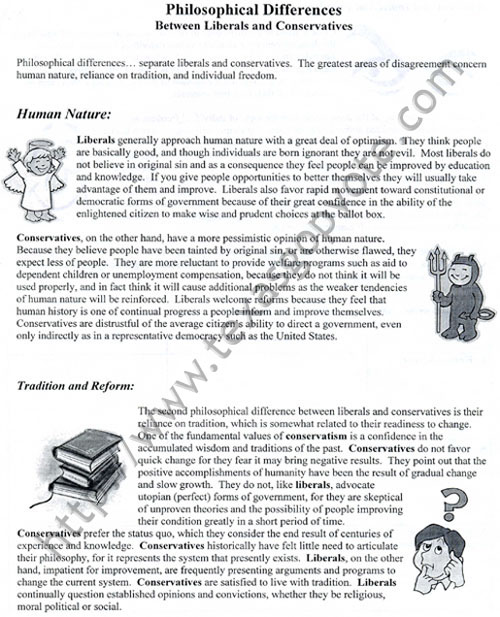
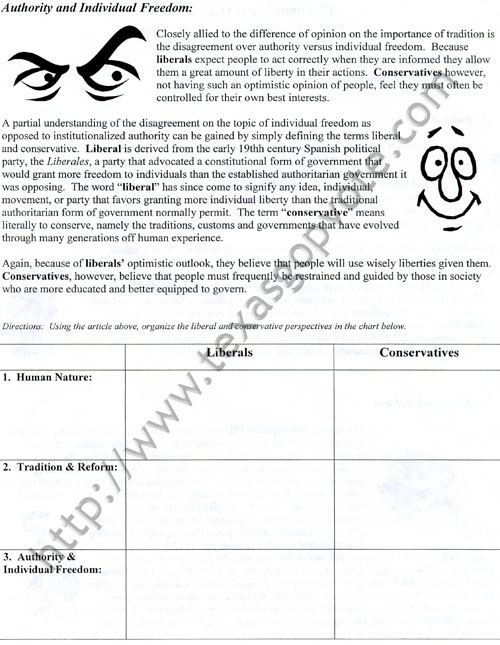
More murky however is the subtle indoctrination into the cult of Mother Earth. I've noticed that many activities my daughter's current school hold involve some tie to "Saving the Earth". Recycling drives, plays with an environmental theme. Activities centered around Earth Day. Hey, don't get me wrong. Recycling is great. I do it myself, from the obvious aluminum and paper to the less-clearly-beneficial glass and plastics. I don't mind a teacher telling her students about the benefits of it, or even championing it. But when my daughter is told in school that the Earth is "our Mother" I start to get leery. I haven't said anything to her school or her teacher; I don't think it's at that point yet. My daughter hasn't started telling me to get rid of my pickup or to boycott BP yet.
All of it plays into the general insecurity I think all parents feel; am I teaching my child everything she needs to know? Am I protecting her from bad teachers? Is she going to have my values when she grows up, and, if not, is it because I didn't do enough to instill them in her? It's enough to drive you crazy until you realize that all you can do is all you can do. I have to have faith that she is going to grow up smart and adopt the values that she knows are right while discarding the rest. She's bound to make mistakes along the way; believe propaganda rather than embrace facts on a topic near to her heart. All I can do is hope that she develops the wisdom to recognize those situations and the fortitude to correct them.
(Crossposted from Say Anything)
Thursday, April 29, 2010
Where's The Outrage Over Gas Prices?
In 2004, then President Bush was under fire for not doing enough to curb the high price of gas at the pump. There was the usual attempts to wrap the criticism in the flag and play up the suffering of "ordinary Americans".
Flashforward to 2006: gas prices had doubled since Bush first took office in 2001. The price of a gallon of gas was now approaching $3.00 a gallon in some areas. Democrats were outraged. The public was outraged. Everyone was outraged. A huge business opportunity was lost when no one could come up with a workable plan to fuel combustion engines on outrage. It was clear that Bush and the oil companies were in cahoots. Congress was swift to act by pushing legislation to impose windfall profit taxes on oil companies. Finally, we were told, the national nightmare of $3.00 per gallon gas prices was ending.
In April of 2006, Bush announced a plan to halt oil purchases for the strategic oil reserve, leaving more oil on the open market in a bid to lower gas prices.
It's now October 2006. Gas prices have fallen into the low $2 range. Democrats lined up to praise the president for addressing the issue and getting prices lower, just as they had been calling for. Op-ed pieces across the land hailed the end of high gas prices. Everyone was happy
No, just kidding. Instead, the op-ed pages were filled with speculation about whether Bush was now conspiring with oil companies to lower gas prices.
By 2008 gas prices were on the rise again. There was an election coming up, but for some reason Bush and the oil companies decided not to lower the price of oil to help out John McCain. This didn't win him any points with the media though. No, now high gas prices at a time when low ones would be politically savvy were actually going to help Bush.
Your friend and mine, Nancy Pelosi, penned a press release calling for investigations and an end to tax subsidies and all kinds of neat sound and fury stuff.
Mr. President, we have worked together to enact the first increase in fuel economy standards for cars and trucks in 32 years, dramatically boosting efficiency standards for buildings, lighting, and appliances, and investing in homegrown biofuels. I respectfully ask you again to work with the Congress to allow the Justice Department to pursue oil cartel price-fixing, allow the Federal Trade Commission (FTC) the authority to investigate and punish price gougers, end taxpayer subsidies to Big Oil and invest those funds in renewable American energy. Lastly, your Administration must use the authority given to it by the Congress to end market manipulation. We cannot wait to act in the face of these prices increases.Some of her rhetoric was good. I'm all for ending tax subsidies for oil companies. Where the Speaker and I part ways is that I also support ending them for farmers, auto companies, banks, unions, etc.
Now it is 2010. We aren't all riding public transportation to work. Wind farms aren't abundant. Neither is solar energy, steam power, flower power, hopenchange power or any other power except good ole fossil fuels. That is not to say anyone should expect oil to have been replaced by these things by April, 2010. But shouldn't we be a lot closer than we are if it were so bloody important?
I mean, I would have at least expected Washington D.C. to become a leader in alternative energy. A pilot wind power program. Solar panels on the Captiol Building. A saw mill on the Potomac. Something. Instead, we have calls for the ramping up of nuclear plants and the price of gas is still near $3.00 in most places.
Is the price of gas now unmoored from the actions of the President? Is $3.00 gas suddenly the result of market forces? Are "ordinary Americans" no longer burdened by high gas prices? Is there no need for the President to "do something"? Are the powers that be no longer reaping profits from the backs of car owners? Shouldn't the FTC and the Justice Department get involved?
Where's the outrage?
At a hearing of the Senate Armed Services Committee, Energy Secretary Spencer Abraham said the administration would not temporarily stop filling the Strategic Petroleum Reserve to help lower oil prices and it would not publicly call on OPEC to roll back production cuts scheduled for April 1.People were suffering, soldiers were dying and Bush wasn't doing anything about it. The price of a gallon of gas at the time of the above quote: $1.74.
"We've ... made clear we're not going to beg for oil," said Mr. Abraham, although he later told reporters that the administration has been working behind the scenes to try to bring prices down.
"We have had a lot of contacts at a lot of levels," he said.
"We're not begging," said Sen. Edward M. Kennedy, Massachusetts Democrat. "We have men and women over there" in Iraq.
Iraq has the world's second-largest oil reserves after Saudi Arabia. The slow revival of exports from Iraq, despite U.S. control of the country, has been a factor driving up oil prices.
Mr. Kennedy and other committee Democrats said they were outraged that the administration is not doing everything in its power to alleviate the strain on drivers, consumers and businesses.
Flashforward to 2006: gas prices had doubled since Bush first took office in 2001. The price of a gallon of gas was now approaching $3.00 a gallon in some areas. Democrats were outraged. The public was outraged. Everyone was outraged. A huge business opportunity was lost when no one could come up with a workable plan to fuel combustion engines on outrage. It was clear that Bush and the oil companies were in cahoots. Congress was swift to act by pushing legislation to impose windfall profit taxes on oil companies. Finally, we were told, the national nightmare of $3.00 per gallon gas prices was ending.
In April of 2006, Bush announced a plan to halt oil purchases for the strategic oil reserve, leaving more oil on the open market in a bid to lower gas prices.
Bush said the nation’s strategic petroleum reserve had enough fuel to guard against any major supply disruption over the next few months.This is not to imply that withholding oil from the strategic reserve and relaxing some EPA rules in and of themselves magically lowered gas prices. But the president was taking steps. He was "doing something".
“So, by deferring deposits until the fall, we’ll leave a little more oil on the market. Every little bit helps,” he said.
Wholesale gasoline futures prices for June delivery dropped 8 cents a gallon to $2.10 on the New York Mercantile Exchange immediately upon Bush’s remarks.
In a separate development, Bush ordered a temporary suspension of environmental rules for gasoline.
Easing the environment rules will allow refiners greater flexibility in providing oil supplies since they will not have to use certain additives such as ethanol to meet clean air standards. The suspension of oil purchases for the federal emergency oil reserve is likely to have only modest impact since relative little extra oil will be involved.
It's now October 2006. Gas prices have fallen into the low $2 range. Democrats lined up to praise the president for addressing the issue and getting prices lower, just as they had been calling for. Op-ed pieces across the land hailed the end of high gas prices. Everyone was happy
No, just kidding. Instead, the op-ed pages were filled with speculation about whether Bush was now conspiring with oil companies to lower gas prices.
Of course, the relationship between commodity prices and electoral results is a noisy one. A host of other factors could influence the polls and, ultimately, control of Congress, like Bob Woodward's book, or Rep. Mark Foley's instant messages, or Macacawitz-gate. But that hasn't stopped speculation about conspiracies led by the Bush administration, and those close to it, to engineer a sharp fall in the prices of oil and gas during campaign season. A big chunk of the American public suspects funny business. A USA Today poll from September found that 42 percent of Americans believed the administration deliberately manipulated gas prices ahead of the elections.In other words, 58% didn't believe that.
By 2008 gas prices were on the rise again. There was an election coming up, but for some reason Bush and the oil companies decided not to lower the price of oil to help out John McCain. This didn't win him any points with the media though. No, now high gas prices at a time when low ones would be politically savvy were actually going to help Bush.
Contrived or otherwise, today's soaring gas prices are a tangible bonanza for Bush/McCain. Offshore drilling would put billions in their cronies' pockets, but would not lower gas prices a single cent. Nuke power could mean billions more in radioactive lucre for reactor builders who may never deliver a single electron of electricity.I could cut and paste that whole crazy rant, but for one thing it would be poor netiquette and for another I don't want to make your brain hurt.
Your friend and mine, Nancy Pelosi, penned a press release calling for investigations and an end to tax subsidies and all kinds of neat sound and fury stuff.
Mr. President, we have worked together to enact the first increase in fuel economy standards for cars and trucks in 32 years, dramatically boosting efficiency standards for buildings, lighting, and appliances, and investing in homegrown biofuels. I respectfully ask you again to work with the Congress to allow the Justice Department to pursue oil cartel price-fixing, allow the Federal Trade Commission (FTC) the authority to investigate and punish price gougers, end taxpayer subsidies to Big Oil and invest those funds in renewable American energy. Lastly, your Administration must use the authority given to it by the Congress to end market manipulation. We cannot wait to act in the face of these prices increases.Some of her rhetoric was good. I'm all for ending tax subsidies for oil companies. Where the Speaker and I part ways is that I also support ending them for farmers, auto companies, banks, unions, etc.
Now it is 2010. We aren't all riding public transportation to work. Wind farms aren't abundant. Neither is solar energy, steam power, flower power, hopenchange power or any other power except good ole fossil fuels. That is not to say anyone should expect oil to have been replaced by these things by April, 2010. But shouldn't we be a lot closer than we are if it were so bloody important?
I mean, I would have at least expected Washington D.C. to become a leader in alternative energy. A pilot wind power program. Solar panels on the Captiol Building. A saw mill on the Potomac. Something. Instead, we have calls for the ramping up of nuclear plants and the price of gas is still near $3.00 in most places.
Is the price of gas now unmoored from the actions of the President? Is $3.00 gas suddenly the result of market forces? Are "ordinary Americans" no longer burdened by high gas prices? Is there no need for the President to "do something"? Are the powers that be no longer reaping profits from the backs of car owners? Shouldn't the FTC and the Justice Department get involved?
Where's the outrage?
Friday, April 23, 2010
Time For South Park To Move On
[WARNING: this post contains strong language and depicts scenes some closeminded, uptight, sensitive people are likely to find offensive. Trust me though: they're really really funny.]
In the wake of the latest French Maneuver by South Park network Comedy Central, creators Trey Parker and Matt Stone have shown none of the willingness to forgive that they did after their first controversial episode in which the Muslim prophet Muhammed was censored by executive decree.
You like watching Republicans get lampooned? One episode referred to a conservative talk show guest on The O'Reilly Factor as a "pissed-off white-trash redneck conservative". If you're the type that thinks making fun of the Right is funny, but the Left isn't to be mocked, you wouldn't like South Park. The other guest was identified only by "aging hippie liberal douche".
South Park makes fun of the handicapped. It has not one but two handicapped characters. The first, named Timmy, can only communicate by saying his name in different cadences and volumes. The second, Jimmy, needs crutches to walk and has a severe stutter. Naturally, Jimmy was introduced in an episode where he challenges Timmy's status as primary crippled character in an episode called "Cripple Fight". The halves of a two-part episode were titled, "Do The Handicapped Go To Hell" and "Probably".
Celebrities have taken more than their share of punishment from Rob Reiner (anti-smoking crusader who constantly has a cheeseburger in his hand) to Sally Struthers (African adoption advocate who looks and talks like Jabba the Hutt) to Barbra Streisand (depicted as a 100-foot-tall mechanized Godzilla-like creature who tries to destroy the town). Tom Cruise-bashing is practically a subplot on the show. Originally questioning his sexuality in an episode called "Trapped In The Closet", in which the actor literally spent almost the entire episode in a closet, refusing to come out, the show fired shots in his direction sporadically, culminating in the show's 200th episode (titled "200") in which Cruise leads all the celebrities lampooned over the years first in an effort to sue the town and later in a plot that set off the latest controversy.
Cruise realizes that there's one person who is absolutely untouchable when it comes to satire -- the prophet Muhammed. He agrees to drop the lawsuit against the town if the citizens will deliver Muhammed to him. His plan is to use a device (built by Rob Reiner) to steal Muhammed's "goo", a magical substance that will make Tom Cruise untouchable.
While you may think the plot is silly (and it is -- that Parker and Stone can make such a ridiculous plot not only funny but expected is part of their peculiar genius), it doesn't sound like anything to get up in arms about. You would be wrong. After "200" aired, a Muslim group made a statement warning the creators that they were walking a dangerous path.
The singular saving grace that keeps South Park relevant and fresh is the fact that they skewer every religion (as well as everything else). Not equally. Truth be told, Christianity has taken by far the most abuse. From a town priest that's been caught "giving a blessing" to a nun in the confessional to depicting the Pope as a dessicated old man who can only speak in grunts, the show has been absolutely brutal to the sensibilites of Christians of more delicate constitutions. In one episode ("Bloody Mary"), a bleeding statue of the Virgin Mary is originally identified as miraculous but is later disavowed when a visiting Cardinal realizes it is bleeding from its, um, ladyparts, declaring "A chick bleeding out her vagina is no miracle. Chicks bleed out their vaginas all the time." If you like your Christian satire to be more Ned Flanders and less a show where Satan's boyfriend is Sadam Hussein, than you're likely to be offended by South Park.
And that's okay. You don't have to like it. But you should support it's right to exist and to "do what it does". Because the show doesn't just skewer Christianity. One of the shows regular characters, Chef (voiced by Shaft signer Isaac Hayes) was killed off after the actor voiced displeasure with the show's treatment of his religion, Scientology. Mormons, Hindus, Buddhists, atheists, Christians -- poking fun with the sharpest stick possible didn't present a problem. When the stick got pointed at his own sacred cow, Hayes got mad. Parker and Stone got their "revenge" with the biggest "f--k you" episode in television history. The point they were trying to make was obvious: this show makes fun of everything. If anything is off the table, then it all has to be off the table. And with one exception, Comedy Central has laughed at protesters, threats and boycotts all the way to the bank.
Comedy Central's cowardice was excused by Parker and Stone the first time around, because, the network was honest about their motivation -- they were "scared of getting blown up". In that episode, the creators wanted to depict Muhammed in a non-satirical manner. He was to be shown handing a football helmet to Family Guy's Peter Griffin. That's it. When the scene was supposed to air, viewers instead saw a black screen with the words, "Comedy Central has refused to broadcast an image of Mohammed on their network". To show just how cowardly the network was and how willing they were to kowtow to any group who threatened violence (as opposed to boycotts and protests), the end of the episode depicted Jesus Christ and then-President George Bush defecating all over each other and an American flag. It was a disgusting image. The only thing more disgusting was the rank hypocrisy Comedy Central displayed in greenlighting it while censoring a cartoon image of Muhammed holding a football helmet. Let me be clear here: the network had a choice, allow both the Muhammed depiction and the Christ/Bush scene, or allow neither. I personally would vote for "allow both". The more squeamish among us might say "allow neither". Comedy Central chose the most cowardly path: greenlighting angering groups they knew would pose no physical threat while caving in to a group from whom they feared violence.
This time though, Parker and Stone are genuinely mad. They're getting tired of the network standing behind them on every controversy that comes along except for this one thing. It's clear that Comedy Central is too skittish to do what's right. I'm not privy to the inner workings of their contract with the network. I do know that South Park is too dedicated to free speech to remain on a cowardly network like Comedy Central. I think Parker and Stone should look for a new home. Free speech isn't easy to live with. It requires you to put up with hearing things you don't like. I'll let this exchange from the episode "Cartoon Wars (part 1)", in which the townspeople mull over how to repsond to the threat of Muslim violence, serve as the last word:
In the wake of the latest French Maneuver by South Park network Comedy Central, creators Trey Parker and Matt Stone have shown none of the willingness to forgive that they did after their first controversial episode in which the Muslim prophet Muhammed was censored by executive decree.
“In the 14 years we’ve been doing South Park we have never done a show that we couldn’t stand behind. We delivered our version of the show to Comedy Central and they made a determination to alter the episode. It wasn’t some meta-joke on our part. Comedy Central added the bleeps. In fact, Kyle’s customary final speech was about intimidation and fear. It didn’t mention Muhammad at all but it got bleeped too. We’ll be back next week with a whole new show about something completely different and we’ll see what happens to it.”What was all the fuss about? Well, if you're unfamiliar with South Park consider yourself a poorer person now than you were when you started this sentence. It's a show that uses crude animation to tell the adventures of four young boys in South Park, Colorado. They are crude, rude, profane and endlessly funny. It's the type of show you either love or hate, depending on your ability to laugh at sacred cows. In a world where shows like Fox and Friends and The Daily Show claim to be equal opportunity offenders but are really ideological shills, Parker and Stone truly go out of their way to offend every sacred cow on every side of every aisle.
You like watching Republicans get lampooned? One episode referred to a conservative talk show guest on The O'Reilly Factor as a "pissed-off white-trash redneck conservative". If you're the type that thinks making fun of the Right is funny, but the Left isn't to be mocked, you wouldn't like South Park. The other guest was identified only by "aging hippie liberal douche".
South Park makes fun of the handicapped. It has not one but two handicapped characters. The first, named Timmy, can only communicate by saying his name in different cadences and volumes. The second, Jimmy, needs crutches to walk and has a severe stutter. Naturally, Jimmy was introduced in an episode where he challenges Timmy's status as primary crippled character in an episode called "Cripple Fight". The halves of a two-part episode were titled, "Do The Handicapped Go To Hell" and "Probably".
Celebrities have taken more than their share of punishment from Rob Reiner (anti-smoking crusader who constantly has a cheeseburger in his hand) to Sally Struthers (African adoption advocate who looks and talks like Jabba the Hutt) to Barbra Streisand (depicted as a 100-foot-tall mechanized Godzilla-like creature who tries to destroy the town). Tom Cruise-bashing is practically a subplot on the show. Originally questioning his sexuality in an episode called "Trapped In The Closet", in which the actor literally spent almost the entire episode in a closet, refusing to come out, the show fired shots in his direction sporadically, culminating in the show's 200th episode (titled "200") in which Cruise leads all the celebrities lampooned over the years first in an effort to sue the town and later in a plot that set off the latest controversy.
Cruise realizes that there's one person who is absolutely untouchable when it comes to satire -- the prophet Muhammed. He agrees to drop the lawsuit against the town if the citizens will deliver Muhammed to him. His plan is to use a device (built by Rob Reiner) to steal Muhammed's "goo", a magical substance that will make Tom Cruise untouchable.
While you may think the plot is silly (and it is -- that Parker and Stone can make such a ridiculous plot not only funny but expected is part of their peculiar genius), it doesn't sound like anything to get up in arms about. You would be wrong. After "200" aired, a Muslim group made a statement warning the creators that they were walking a dangerous path.
"We have to warn Matt and Trey that what they are doing is stupid and they will probably wind up like Theo Van Gogh for airing this show," Al-Amrikee wrote. "This is not a threat, but a warning of the reality of what will likely happen to them."I especially like the covering statement at the end. Hey we're not threatening you. We're just saying that if you keep doing what you're doing, you're likely to end up shot and stabbed to death in the street. Just telling it like it is, man. Riiiiight.
The singular saving grace that keeps South Park relevant and fresh is the fact that they skewer every religion (as well as everything else). Not equally. Truth be told, Christianity has taken by far the most abuse. From a town priest that's been caught "giving a blessing" to a nun in the confessional to depicting the Pope as a dessicated old man who can only speak in grunts, the show has been absolutely brutal to the sensibilites of Christians of more delicate constitutions. In one episode ("Bloody Mary"), a bleeding statue of the Virgin Mary is originally identified as miraculous but is later disavowed when a visiting Cardinal realizes it is bleeding from its, um, ladyparts, declaring "A chick bleeding out her vagina is no miracle. Chicks bleed out their vaginas all the time." If you like your Christian satire to be more Ned Flanders and less a show where Satan's boyfriend is Sadam Hussein, than you're likely to be offended by South Park.
And that's okay. You don't have to like it. But you should support it's right to exist and to "do what it does". Because the show doesn't just skewer Christianity. One of the shows regular characters, Chef (voiced by Shaft signer Isaac Hayes) was killed off after the actor voiced displeasure with the show's treatment of his religion, Scientology. Mormons, Hindus, Buddhists, atheists, Christians -- poking fun with the sharpest stick possible didn't present a problem. When the stick got pointed at his own sacred cow, Hayes got mad. Parker and Stone got their "revenge" with the biggest "f--k you" episode in television history. The point they were trying to make was obvious: this show makes fun of everything. If anything is off the table, then it all has to be off the table. And with one exception, Comedy Central has laughed at protesters, threats and boycotts all the way to the bank.
Comedy Central's cowardice was excused by Parker and Stone the first time around, because, the network was honest about their motivation -- they were "scared of getting blown up". In that episode, the creators wanted to depict Muhammed in a non-satirical manner. He was to be shown handing a football helmet to Family Guy's Peter Griffin. That's it. When the scene was supposed to air, viewers instead saw a black screen with the words, "Comedy Central has refused to broadcast an image of Mohammed on their network". To show just how cowardly the network was and how willing they were to kowtow to any group who threatened violence (as opposed to boycotts and protests), the end of the episode depicted Jesus Christ and then-President George Bush defecating all over each other and an American flag. It was a disgusting image. The only thing more disgusting was the rank hypocrisy Comedy Central displayed in greenlighting it while censoring a cartoon image of Muhammed holding a football helmet. Let me be clear here: the network had a choice, allow both the Muhammed depiction and the Christ/Bush scene, or allow neither. I personally would vote for "allow both". The more squeamish among us might say "allow neither". Comedy Central chose the most cowardly path: greenlighting angering groups they knew would pose no physical threat while caving in to a group from whom they feared violence.
This time though, Parker and Stone are genuinely mad. They're getting tired of the network standing behind them on every controversy that comes along except for this one thing. It's clear that Comedy Central is too skittish to do what's right. I'm not privy to the inner workings of their contract with the network. I do know that South Park is too dedicated to free speech to remain on a cowardly network like Comedy Central. I think Parker and Stone should look for a new home. Free speech isn't easy to live with. It requires you to put up with hearing things you don't like. I'll let this exchange from the episode "Cartoon Wars (part 1)", in which the townspeople mull over how to repsond to the threat of Muslim violence, serve as the last word:
Professor Thomas: "We bury our heads. In sand. We take twenty to twenty-five dump trucks, fill them with sand from Monarch Lake, and then dump the sand along South Park Avenue. By using approximately eighteen dozen shovels, we can each dig a hole in the sand, stick our heads in the holes, and then have the person to our left bury them. If we can manage to get every person's head buried deep, deep in sand before the Muhammad episode airs, we could avoid looking like we're responsible for any part of this at all."And then you're Canada. Nobody wants that.
Stephen: "No, no, wait a minute, it's ridiculous. What we need to do is just the opposite. Freedom of speech is at stake here, don't you all see? If anything, we should ALL make cartoons of Muhammad, and show the terrorists and the extremists that we are all united in the belief that every person has a right to say what they want! Look, people, it's... been real easy for us to stand up for free speech lately. For the past few decades we haven't had to risk anything to defend it. But those times are going to come! And one of those times is right now. And if we aren't willing to risk what we have, then we just believe in free speech, but we don't defend it.
Subscribe to:
Posts (Atom)